


It can be difficult to pin down the factors influencing Donald Trump a month into the US and Israel's campaign of military action on Iran.
But it is apparent he has an eye on the global crude markets.
A word – or social media post – from the US president concerning his plans once would ignite substantial swings in oil prices, as investors seized upon indications the hostilities could escalate or de-escalate.
However, in the last week, investors appear to be becoming increasingly sceptical about the value of his pronouncements.
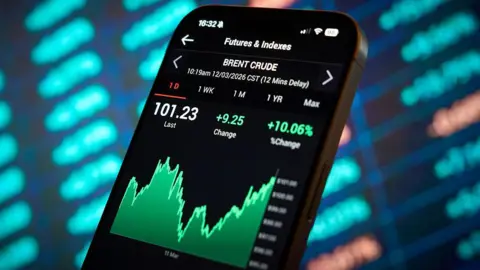
Oil was valued at approximately $72 a barrel (bbl) before 28 February, when the strikes on Iran began.
The week prior, it climbed to $118 a barrel on 19 March and as of Friday afternoon was trading at around $112 – substantially higher than its pre-conflict price.
Here are some moments from the past month where Trump and the financial markets appear to have bounced off each other – with differing results.
Navigate with the arrow to advance to the following chart.
"Energy prices have become a proxy for broader political and financial uncertainties, spiking when Trump's tone grows confrontational and declining when his language softens," observes one investment manager.
He states that markets are understandably reactive to those messages, given the substantial financial dangers that are associated with rising oil prices.
"Traders are trying to assess genuine volatility," he explains. "Markets can seem jumpy or uncertain, but what they're actually doing is managing geopolitical risk in real time, with oil positioned directly at the centre of that."
But, it can be challenging for traders to determine how to position themselves, especially since a portion of Trump's statements seem designed to influencing oil prices, rather than articulating policy, argues another market commentator.
"As the saying goes, the initial victim of conflict is truth," he remarks. "My belief is much of the rhetoric back-and-forth around diplomatic progress, and the opposite, very much are aimed at simply moving the market price of oil."
Investor Response Grow More Subdued
On a recent Thursday, moments after US stock markets saw their largest decline since the beginning of the Iran war, Trump stated talks with Iran were going "very well" and he was delaying military strikes on Iran's energy infrastructure until at least 6 April.
But, the oil price continued to increase.
One head of FX strategy explains that investor responses are "growing increasingly subdued" because of the "wide divergence" between Trump's optimistic statements and the lack of response from Tehran.
"Given the optics, a large number of market watchers cannot envision an quick end to the conflict and markets continue to be anxious."
Another market expert says markets have also adapted to Trump "frequently changing tack at hints of geopolitical, stock market or financial stress".
"We are seeing a degree of wariness, or even outright distrust, taking hold at the margins," he concludes.


